How Sovereign Wealth Allocates Capital
The shift from conservative fixed-income parking to aggressive alternative asset deployment over the last 15 years.
The Illiquidity Premium Myth
Historically, Sovereign Wealth Funds (SWFs) acted as stabilization mechanisms for commodity-driven economies. Capital was parked in highly liquid US Treasuries and global sovereign debt. However, the zero-interest-rate policy (ZIRP) era following the 2008 financial crisis forced a paradigm shift.
Facing diminished yields, SWFs drastically altered their target allocations. The "Endowment Model" (pioneered by Yale) was scaled up to the nation-state level. Funds sought the illiquidity premium—the theoretical excess return investors demand for locking up capital in private equity, infrastructure, and real estate.
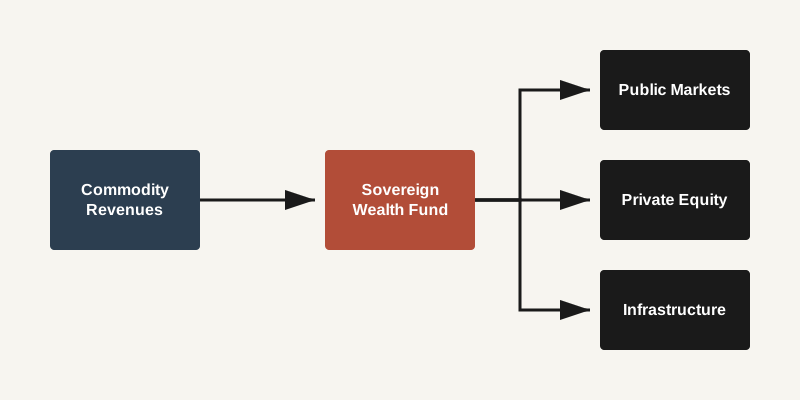
Fig 1. The typical capitalization structure of a commodity-based Sovereign Wealth Fund.
Allocation Shift (2010 vs 2024)
| Asset Class | 2010 Avg % | 2024 Avg % |
|---|---|---|
| Fixed Income | 45% | 22% |
| Public Equities | 40% | 46% |
| Alternatives (PE, RE, Infra) | 15% | 32% |
* ISW Aggregate Data of Top 50 Funds.
Direct vs. Indirect Deployment
As allocations to private markets exploded, SWFs realized that paying standard "2 and 20" fee structures (2% management fee, 20% performance fee) to private equity GPs was destroying their alpha at scale.
The response was a move toward direct investing and co-investments. Funds like GIC and Mubadala built massive internal teams to bypass Wall Street intermediaries. You can read a detailed breakdown in our Direct vs. Indirect guide.
The GP Fee Drag Calculator
Why SWFs bring operations in-house: Calculate the compounded capital lost to basic management fees on a private market allocation.
The NBIM Exception
It is vital to note that the world's largest SWF, Norway's NBIM, firmly rejects the alternative asset model. Constrained by strict parliamentary mandates regarding liquidity and transparency, NBIM holds virtually zero private equity. They rely entirely on massive diversification across global public equities (owning roughly 1.5% of all globally listed shares) and public fixed income.
FAQ
- Why don't SWFs invest heavily in their domestic markets?
- Historically, investing domestically caused "Dutch Disease"—currency inflation that harms export competitiveness. The goal was to offshore excess capital. However, "Development Funds" like PIF or Temasek break this rule explicitly to foster domestic industries.
- How do geopolitical tensions affect allocation?
- Significantly. Following sanctions on Russian reserves in 2022, Middle Eastern and Asian funds accelerated their diversification away from purely US-dollar-denominated assets and US infrastructure, increasing allocations to intra-regional Asian assets and European real estate.